Oklahoma’s Licence Moratorium Did Not Freeze the Market. It Forced a Long Contraction
By THC Gazette ·
Four years after Oklahoma stopped issuing new grower, processor and dispensary licences, the protected pool is dramatically smaller and a 2026 extension has moved any general reopening to 2028.
Oklahoma’s medical marijuana licence moratorium is sometimes described as a cap. The market record shows something more consequential. The state stopped admitting new growers, processors and dispensaries while continuing to require the businesses already inside the system to renew, comply and survive.
That distinction explains why the number of licences did not remain level after the moratorium began on August 26, 2022. Oklahoma Medical Marijuana Authority data show a steep reduction across every plant-touching commercial category. The August 2022 report listed 7,346 growers, 2,335 dispensaries and 1,438 processors. OMMA’s August 3, 2026 report listed 1,801 growers, 1,323 dispensaries and 587 processors.
In simple percentage terms, the grower count fell about 75 percent, the processor count about 59 percent and the dispensary count about 43 percent. The three categories together declined from 11,119 licences to 3,711, a reduction of roughly two-thirds.
Those figures are not proof that the moratorium alone caused every closure or nonrenewal. Patient participation also declined, enforcement intensified, operators faced ordinary business failures, and Oklahoma added requirements beyond the entry pause. OMMA’s own licensing-data notes say changes in statutes and regulations, licence surrenders and the treatment of expired licences can affect the totals. What the numbers do establish is that the moratorium did not preserve the competitive field as it existed in 2022. It closed the front door while attrition reshaped the room.
What the moratorium actually covers
The pause applies to new grower, processor and dispensary licences. Existing businesses may renew. Oklahoma law also makes room for licences necessitated by changes in ownership or location, subject to regulatory review. The rule therefore restricts de novo entry; it does not make the current licence pool permanently immovable.
The Legislature first created the moratorium through House Bill 3208. House Bill 2095 later moved the scheduled end to August 1, 2026. Before that date arrived, lawmakers passed House Bill 3143. The governor approved the bill on May 5, 2026, and OMMA now tells applicants that the moratorium runs until August 1, 2028 unless the agency’s executive director ends it earlier after pending reviews, inspections and investigations are complete.
HB 3143 also tightened the treatment of ownership transfers when a licensee faces an administrative action or appeal. That matters because a restricted-entry market makes existing licences more strategically important, but a licence subject to discipline cannot simply be treated as a clean asset available for transfer.
The result is a market with two different kinds of competition. Operators still compete for patients and retail sales. Prospective entrants compete, where possible, for ownership of an existing compliant business rather than for a newly issued operating licence.
A smaller customer base and softer tax receipts
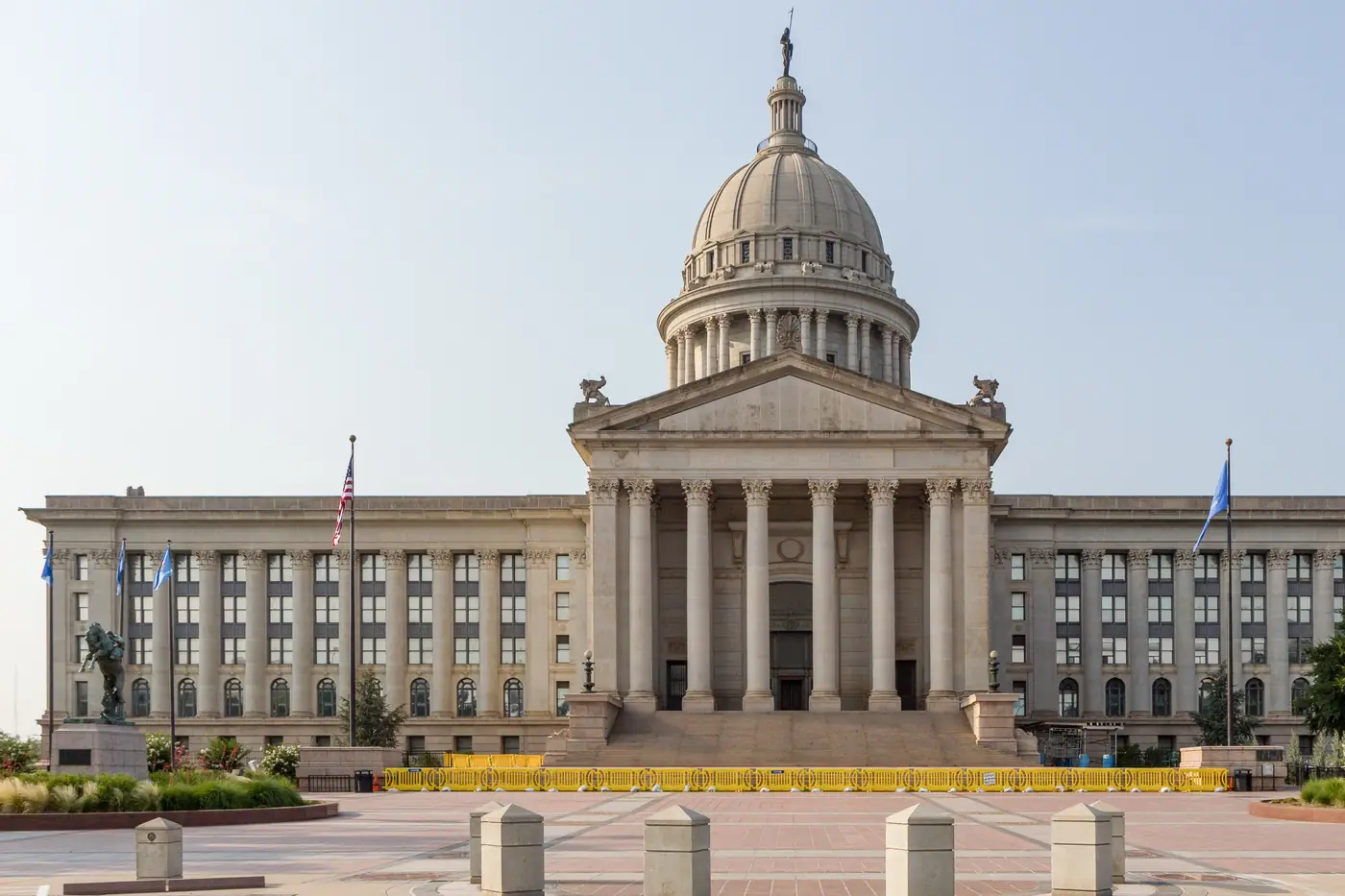
The Oklahoma State Capitol in Oklahoma City. Photo by Steve, adjusted by Filetime, licensed under CC BY-SA 2.0. Image source
The supply side was not the only part of the programme that contracted. OMMA reported 383,363 patient licences in August 2022 and 307,583 in August 2026, a decline of about 20 percent. On a per-patient basis, Oklahoma still has an unusually dense retail system: the August 2026 report equates to roughly one dispensary for every 233 patients. That is a mechanical ratio, not a measure of active customer traffic, but it shows why a lower dispensary count does not necessarily mean a scarce retail market.
The tax series points in the same broad direction. State Question 788 excise-tax collections were $55.0 million in calendar 2022 and $45.3 million in 2025. July collections declined from $4.21 million in 2022 to $3.50 million in 2026. Tax receipts are influenced by spending, product mix, pricing and reporting timing, so they should not be read as a direct count of demand. They do show that the commercial base did not shrink while consumer-side dollars expanded enough to offset it.
Oversupply came before consolidation
The state entered the moratorium period with a supply problem already visible. A study commissioned by OMMA and published in 2023 estimated 64 grams of regulated supply for every gram of licensed-patient demand. Using the study’s assumption that a functional market might carry two units of supply for one unit of demand, the report described Oklahoma as having at least 32 times the regulated marijuana necessary for licensed patients.
The study did not measure the effect of four full years of the moratorium; it was an assessment of the market conditions around the period when the pause began. It is therefore best read as the context for consolidation, not a verdict on whether the policy solved the imbalance. OMMA’s response combined tighter market entry with inspections, inventory tracking, enforcement and other regulatory measures.
By August 2026, the licence count had fallen far faster than the patient count. That is consistent with some excess capacity leaving the regulated system. It does not reveal whether remaining production is aligned with demand, whether wholesale prices are sustainable, or how much licensed capacity is actually in use. A licence count measures permission to operate, not output.
What the 2028 extension means
For incumbents, another two years without general new entry limits the immediate risk of a fresh wave of licences. It does not remove competitive pressure. The remaining 1,801 growers and 587 processors still serve a patient population that has been declining, while 1,323 dispensaries divide a market whose excise-tax collections are below their 2022 level.
For would-be entrants, the extension changes the investment question. The relevant path is no longer a near-term application after August 2026. It is the acquisition or relocation of an existing licence where allowed, a wait for early termination by OMMA, or a wait for the statutory date in 2028. Each route carries regulatory conditions that a simple licence-cap narrative misses.
For policymakers, the next useful measure will not be whether the number of licences continues to fall. It will be whether supply, active patient demand, compliance capacity and retail economics move into a durable relationship. Oklahoma has already shown that a moratorium can stop expansion while the market contracts beneath it. The unresolved question is what evidence will justify reopening once the contraction has run its course.
Sources
Oklahoma Medical Marijuana Authority — Licensing and Tax Data — oklahoma.gov
Oklahoma Medical Marijuana Authority — Dispensary License — oklahoma.gov
Oklahoma Legislature — Bill Information for HB 3143 — oklegislature.gov
Oklahoma Medical Marijuana Authority — Supply and Demand Study — oklahoma.gov
Oklahoma Medical Marijuana Authority / Cannabis Public Policy Consulting — An Empirical Assessment of Oklahoma’s Medical Marijuana Market — oklahoma.gov